

📌 TL;DR
Application integration connects operational systems so business processes run across them, usually in real time and record by record.
Data integration combines data from many systems, usually in bulk, so it can be analysed or used consistently, often in a warehouse or lake.
Most enterprises need both: application integration to run the business, data integration to understand it.
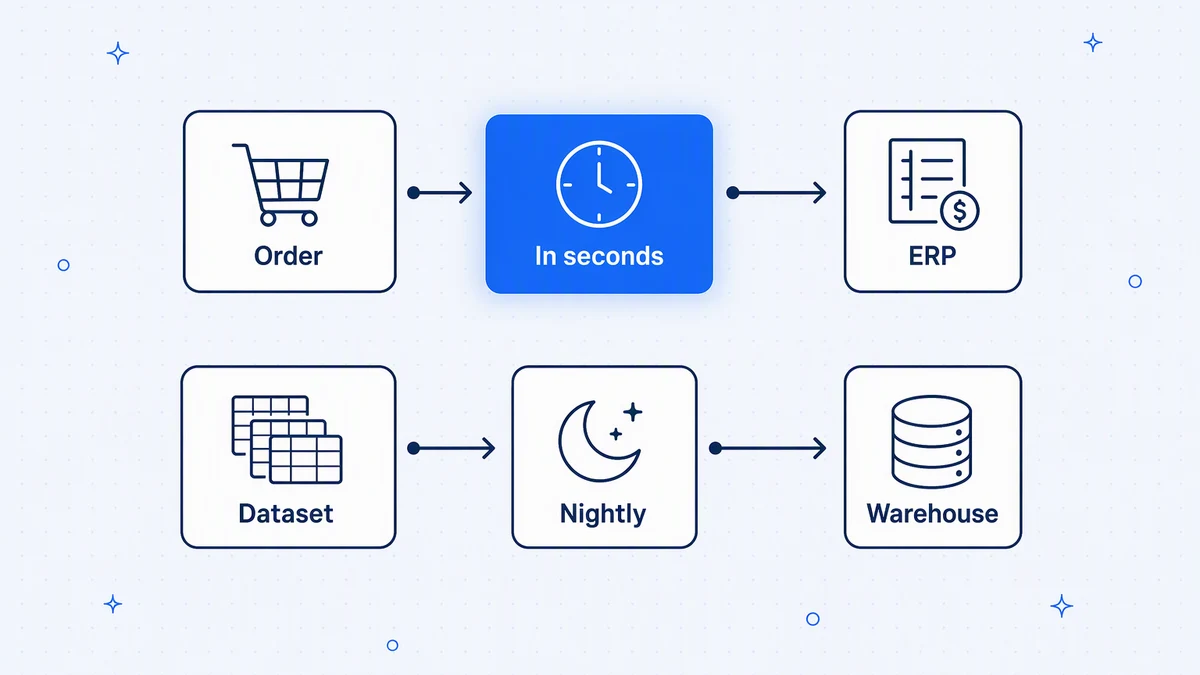
Application integration vs data integration comes down to purpose. Application integration connects operational systems so a business process can run across them: when a deal closes in Salesforce, the order is created in NetSuite and the customer is provisioned in the billing system, usually within seconds. Data integration combines data from many systems so it can be analysed or used consistently, typically by loading it into a data warehouse or lake on a schedule.
They use overlapping tools and are often confused, but they answer different questions, run on different timing, and fail in different ways. This guide compares them and shows when you need each. For a deeper look at the first, see what enterprise application integration is.
What application integration is
Application integration links the systems that run day-to-day operations so they work as one. It's process-oriented: an event in one system triggers actions in others.
- Typical flows: CRM to ERP orders, HR to identity provisioning, ecommerce to warehouse, support to engineering tickets.
- Timing: real time or near real time, record by record.
- Methods: APIs, webhooks, events, and message queues, usually built on an iPaaS.
- Success looks like: the process completes correctly and quickly, every time.
What data integration is
Data integration brings data together from many sources into a consistent form, most often for reporting, analytics, AI, or a single customer view.
- Typical flows: loading ERP, CRM, and marketing data into Snowflake, BigQuery, or Databricks; building a customer 360 dataset.
- Timing: scheduled batches, micro-batches, or continuous change streams.
- Methods: ETL or ELT pipelines, change data capture, and bulk APIs.
- Success looks like: complete, accurate, up-to-date data that analysts and models can trust.
Application integration vs data integration at a glance
| Application integration | Data integration | |
|---|---|---|
| Purpose | Run business processes across systems | Combine data for analysis and consistency |
| Direction | System to system, often both ways | Many sources into one target |
| Timing | Real time, per event | Batch, micro-batch, or streaming |
| Unit of work | A transaction (an order, a hire) | A dataset or table |
| Typical tools | iPaaS, API management, message brokers | ETL/ELT tools, CDC, data pipelines |
| Main users | IT, integration teams, operations | Data engineers, analysts, data scientists |
| When it fails | A process stops: orders don't ship, staff lack access | Reports and models are wrong or stale |
Where they overlap
The line blurs in practice:
- Master data: syncing customers or products across operational systems is application integration, but it shares data quality concerns with data integration.
- Reverse ETL: pushing warehouse insights such as lead scores back into the CRM uses data tools for an operational purpose.
- Change data capture: CDC can feed both a warehouse and operational systems from the same database changes. See CDC and iPaaS.
- Shared platforms: many enterprise iPaaS platforms handle bulk data movement too, and some data tools add light orchestration.
⚠️ Don't run operations off the warehouse
It's tempting to sync systems by routing everything through the data warehouse. But warehouses are optimised for analysis, not for real-time transactions, so a process that depends on a nightly load will always be a day late. Keep operational flows on application integration.
When you need each
Choose application integration when:
- A business process spans several systems and must run without manual steps.
- Changes must reach other systems within seconds or minutes.
- Each transaction matters individually, such as an order, payment, or new hire.
Choose data integration when:
- You need reporting, analytics, or AI across many systems.
- You're consolidating data after an acquisition or building a single customer view.
- Volume is large and freshness requirements are measured in hours, not seconds.
💡 Ask what breaks if the data is late
If a late record stops a customer order or an employee's access, it's application integration. If it makes tomorrow's dashboard slightly stale, it's data integration.
Using both together
A typical enterprise runs both side by side: an iPaaS moves orders, customers, and employees between operational systems in real time, while ELT pipelines load the same systems into a warehouse for finance and analytics. Shared definitions of key entities, such as customer and product, keep the two consistent. See enterprise data integration for the wider architecture.
🧩 How Koodisi handles this
Koodisi is built for application integration: workflows move transactions between ERP, CRM, HR, and other systems in real time through 97 native connectors and a REST Client, with batch processing for larger volumes. Failed records go to Koodisi Engage for retry, so a failed order or hire is fixed rather than lost, and every run is traced and emitted as OpenTelemetry. See workflow orchestration.
✅ Key takeaways
Application integration runs processes; data integration informs decisions.
Use real-time application integration for transactions that matter individually.
Use data integration for analytics, consolidation, and large volumes.
Most enterprises need both, sharing definitions of key entities.
Frequently asked questions
What is the difference between application integration and data integration?
Application integration connects operational systems so processes run across them in real time. Data integration combines data from many systems, usually in bulk, for analysis and consistency.
Is an iPaaS used for application integration or data integration?
Mainly application integration, though many enterprise iPaaS platforms also move bulk data. Dedicated ETL or ELT tools are common for large analytics pipelines.
Is ETL a type of data integration?
Yes. ETL (extract, transform, load) and ELT are the most common methods of data integration for analytics. See ETL vs iPaaS.
Can one platform do both application and data integration?
Some platforms cover both to a degree. Many enterprises still use an iPaaS for operational flows and specialised tools for large analytics pipelines.
Which should I start with?
Start with whichever problem hurts most. If processes break or depend on manual re-entry, start with application integration; if reporting is slow or inconsistent, start with data integration.
Run the business and understand it
Application integration keeps operations moving; data integration makes sense of them. To see how Koodisi connects your operational systems, book a demo.